At first, when I began learning SEO, I had the assumption that keyword research is not complicated. The logic behind my thoughts was to conduct research on the keyword with the largest search volume, create content based on it and wait until my website ranks on Google. That made sense until I figured out that there are thousands of websites that think the same way.
While studying more about SEO and testing things myself on my own website, I figured out that good keyword research does not involve choosing the most searched keyword. Keyword research is based on finding out what people are looking for, why they are looking for it and can you realistically rank for such keywords.
One of those experiences where my thoughts on SEO changed dramatically happened to be when I helped my family’s doll shop. We even did not have a website then – only Google Business profile. After some brainstorming regarding real search intent of our local customers, instead of looking for competitive keywords, we started getting calls of our future clients. This was not a large traffic, but it showed me how important search intent can be sometimes.
If you’re just starting out in SEO, the idea of keyword research may seem overwhelming. You’ll be introduced to things like search volume, keyword difficulty, search intent, long-tail keywords, and competition. It looks like you’d need pricey software and lots of experience to figure out what they all mean. However, there’s great news – you don’t.
In this article, you’ll learn about keyword research from scratch and understand the basics behind this process with the help of examples, free software, and personal knowledge gained throughout my SEO studies.
Table of Contents
What Is Keyword Research?
For instance, consider establishing a café in Kathmandu. Prior to creating a signboard or menu card, you would need to understand whether your clients are searching for “best coffee near me”, “coffee shop in Kathmandu” or “quiet café for studying”. In other words, understanding the search queries of your clients helps you make more accurate decisions.
Keyword research is done in exactly the same way in SEO. Unlike guesswork based on your assumptions, data-driven approach allows you to learn what users type into search engines such as Google. Such words and phrases are known as keywords.
It is common for novices to think of keyword research as the discovery of the keyword with the largest number of searches. The same mistake was made by myself in the early days of my study of SEO. But after some time, I realized that even though some keywords receive thousands of searches per month, they may not be the best option if several hundred other sites compete with you for them.
The key to good keyword research is striking the right balance between relevancy, search demand, and competition. The ideal keyword isn’t necessarily the most searched-for term, but the keyword which suits your content, meets the search demands, and provides a realistic chance for your site to show up in the search engine results pages.
Keyword research can be thought of as an activity where you listen before speaking. Rather than producing content in hopes of getting noticed by anyone, keyword research allows you to find out what the needs of your audience are and then develop content according to those needs.
Why Keyword Research Is the Foundation of Every Successful SEO Strategy

Imagine spending countless hours creating an excellent article. After doing research on the subject, creating attractive images, and publishing it, weeks go by with little or no traffic coming to your site. The issue here may not be with the content but the topic that does not interest your audience as much.
It is exactly the reason why keyword research should come before content creation because with proper research you will learn what users are searching for and create content accordingly. It’s just one part of SEO. If you’d like to understand how all the pieces fit together, check out my complete Beginner SEO Guide.
In simple terms, consider keyword research as the foundation for constructing the building. Even if the final product looks good and impressive, it would not last long without the proper foundation. The same goes for the content; no matter how good it is, it may struggle ranking if it has the wrong keyword.
Another good reason why keyword research is important is because it enables you to understand the search intent that goes into each search. The person who uses the phrase “what is keyword research” as opposed to “best keyword research tools” will have completely different intentions behind using these phrases. Even though these two phrases have something to do with keyword research, their intended purposes are entirely different.
Another great advantage of keyword research is that it helps you to be smart about the time you invest in doing certain things. As a beginner, your instinctive desire will be to target those keywords which have the maximum search volume, as they will yield more traffic for you. However, my experience as an SEO learner has taught me that focusing on the keyword with low competition and good search intent will usually provide more benefits as compared to fighting big and well-established websites in the arena of highly competitive keywords.
In other words, keyword research means researching the needs of your audience, which ultimately helps you to cater to their needs in the form of content.
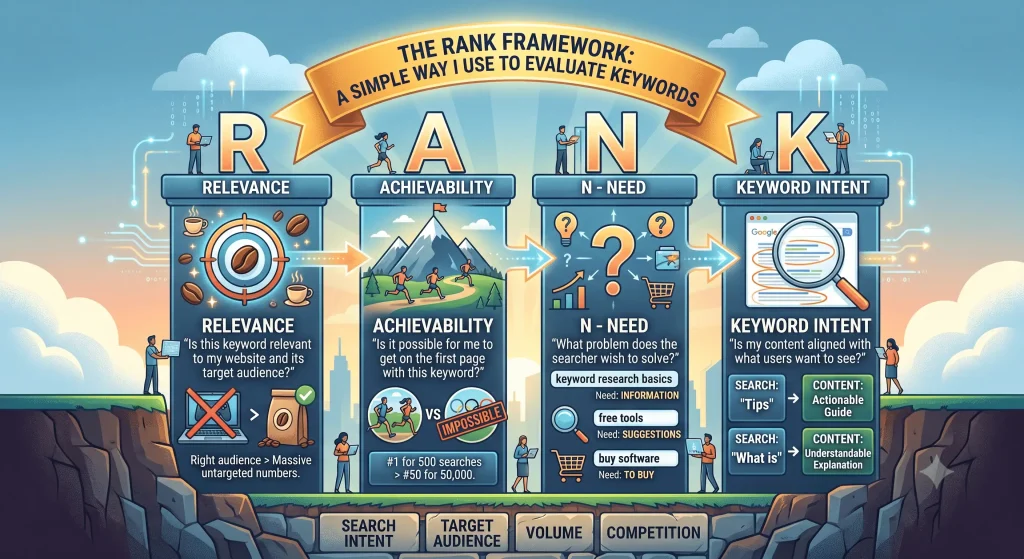
The RANK Framework: A Simple Way I Use to Evaluate Keywords
In my early days of doing keyword research, I was always overwhelmed by all the numerical details like search volume, keyword difficulty, CPC, competition, trends, etc. So many factors to take into account that I got lost in details rather than trying to make an informed decision on which keywords to use.
It turned out that it wasn’t necessary for me to remember the list of dozens of SEO metrics each time I did my keyword research. I just needed to understand whether I should go ahead with a particular keyword or not. It is why I started posing myself four key questions.
I am going to refer to this framework as RANK Framework. This is not an SEO technique or an alternative to keyword researching tools; this is a personal list I use when trying to determine whether a particular keyword is suitable for my site before I start writing anything.
R – Relevance
The first thing I ask myself is:
“Is this keyword relevant to my website and its target audience?”
A keyword can have thousands of monthly searches; however, if it does not correlate with your niche, getting it will bring irrelevant traffic.
For example, suppose that you own a website related to coffee. In this case, “best gaming laptop” can be a keyword with high search volume; however, it is clear that the users searching for it do not need coffee; they need computers. Even if a site managed to get it, these users would leave right away because of content mismatch.
On the contrary, the keyword such as “best coffee beans for beginners” is highly relevant because it brings the targeted audience to the website.
Please, keep in mind that:
The right audience is always more important than the massive number of untargeted audience members.
A – Achievability
Next, I will consider:
“Is it possible for me to get on the first page with this keyword?”
It was one of the most important things that I learned as a beginner SEOer.
As I was learning SEO, at first, I believed that it was essential always to choose the keywords with the highest possible search volume. Then, I understood that these keywords were usually taken by the big and authoritative websites.
If your website is not established yet, it is nearly impossible to compete with Ahrefs, Semrush, HubSpot, and even Wikipedia in the race for the broad keywords.
Try to focus on keywords which are real to rank on the first page. Being #1 for the keyword with 500 searches per month is much more beneficial than being on the 5th page for the keyword with 50,000 searches.
Imagine yourself competing in the local running competition rather than the Olympic Games.
N – Need
The third question is:
“What problem does the searcher wish to solve?”
Nobody searches for keywords for the fun of it – they search because they have a need for an answer, a product, or a solution.
Example:
When somebody searches for “keyword research basics,” they want information.
When somebody searches for “free keyword research tools,” they want suggestions.
When somebody searches for “buy keyword research software,” they might be willing to buy.
Even though these keywords are similar, the problems of the searchers are entirely different.
Make sure you know what problem people have when you write your content.
K – Keyword Intent
And finally, I ask myself the question:
“Is my content aligned with what users want to see?”
The ultimate goal of Google is to provide the user with content that is most suitable for the performed search.
So, when someone is looking for “keyword research tips,” he/she surely expects to get a helpful guide with actionable tips.
When the user is looking for “what is keyword research,” he/she expects to get an understandable explanation.
Thus, if the content does not match the users’ expectations, its chance to rank high will be very slim despite the usage of the keyword in the content.
To determine the search intent, one needs to perform a search on his/her keyword in Google and analyze the type of pages that appear among the top ranking pages.
Putting it All Together
Now whenever I want to write an article, there are four questions I always ask myself:
Is the keyword relevant to my website?
Am I realistically able to compete for the keyword?
Does it help in solving a problem?
Is my content aligned with user intent?
If the answer to all the above four is a yes, then I can say I have found a good keyword to consider.
The above approach has really enabled me to stop being interested in having a high search volume keyword and instead think about having a more relevant one.
How to Find Keywords: My 5-Step Keyword Research Process
Now that you have learned what keyword research is and how I rank my keywords using the RANK framework, the next logical question is:
How do you find good keywords?
When I first began learning SEO, I thought keyword research would mean opening up a tool like Ahrefs or Semrush, entering a word into the tool and selecting the one with the largest search volume.
I soon discovered that keyword research was not about randomly searching for keywords; it is about finding opportunities. The tool merely provides data. You should analyze the data and choose which keywords to target.
With years of practice, I came up with a relatively simple five-step procedure that allows me to organize my keyword research before writing anything.
Step 1: Begin With a Topic, Not a Keyword
One mistake that many beginners make is to open their keyword research tools with absolutely no idea what they actually wish to write about.
Begin with the topic your audience cares about.
Here are some examples of broad topics that may exist in my niche:
- Keyword Research
- Technical SEO
- On-Page SEO
- Google Search Console
- Local SEO
- WordPress SEO
The process of finding keywords will be much simpler after having chosen a topic because all the keywords will necessarily revolve around the topic.
This can be compared to a tree; the topic is like a trunk of the tree and the keywords are like the branches that cannot grow without the trunk.
Step 2: Think Like Your Audience Would
Before even considering the use of any SEO software, take a minute to answer a simple question:
“If I had no knowledge of the subject whatsoever, what would I type into Google?”
This will get you thinking in terms of what your target person would be looking for instead of what an SEO thinks that he/she should be looking for.
For example, a beginner in SEO might have searched for things like:
- What is keyword research?
- How can I find keywords?
- How many keywords do I need?
- What is search volume?
- Free keyword research software
See how the above questions are much more real compared to SEO terminology.
Step 3: Get More Ideas for Keywords from Tools
Now it is time to let these tools do their job and find you more relevant keywords.
Tools that I am using the most are:
Google Search – This tool is helpful for finding Google Autocomplete, “People Also Ask,” and related keywords.
Google Trends – You can find out if a specific keyword is trending up or down.
Ahrefs – Can be used for finding keyword ideas and analyzing competition.
Semrush – Good for variations of keywords and researching competitors.
Ubersuggest – Beginner-friendly tool with good keyword suggestions.
Just remember that these tools don’t select your keywords for you, they provide you with information.
Step 4 — Grouping Your Keywords
This is an aspect that is often missed by many beginner bloggers.
For example:
Your main topic is “Keyword Research”
Do not just list out the keywords. Instead, group them in this way:
Main Keyword Supporting Keywords
Keyword Research keyword research basics
keyword research tips
keyword search volume
keyword research for blogging
free keyword research
local keyword research
Step 5 – Make a Content Plan
In place of stating “select the keyword,” describe what should be done after selecting the keyword.
For instance:
For each and every single article that I write, I make sure that I have planned the content out beforehand when I log into WordPress.
This includes determining:
Primary keyword
Secondary keywords
Questions to be answered
Internal links
Images/diagrams I will require
References I will make
It generally takes me about 15–20 minutes but is worth the effort since everything I am going to write is pre-planned.
This will instantly give you an idea as to which keywords fit into one article instead of writing six weak articles.
And this automatically gives rise to topic clustering which is much more useful than search intent.
The 3 Metrics I Never Ignore Before Choosing a Keyword
It’s very common after going through the process of brainstorming ideas and listing possible keywords to go with the keyword with the most number of searches and write an article on it. It’s what I used to do when I was just starting out with SEO.
With experience, I have learned that there is much more to keyword selection than merely taking into consideration one figure. There are three key figures that I take into account when evaluating a keyword.
1. Search volume – How many people search for the keyword?
Search volume shows the number of times the selected keyword is searched over a certain period, which is typically a month.
First of all, it can appear as though the keyword with higher search volume is the most advantageous. However, it is not always the case.
Suppose you have to choose one of the following keywords:
Keyword Monthly Searches
SEO 50,000
Keyword research basics 500
In most cases, beginners would select SEO since it has much more search volume. However, competitive keywords are usually dominated by authoritative sites having existed for several years.
A keyword with lower number of searches may attract more visitors when there is a real possibility for your website to get onto the first page.
Don’t think about this question: “Which keyword gets more searches?”
Think about this one: “Which keyword can my website realistically rank for?”
2. Keyword Difficulty – How Difficult Is It To Rank?
Keyword difficulty (KD) measures how competitive a keyword is. All SEO tools give this measure; yet, the calculation methods vary from one to another.
Lower keyword difficulty usually indicates that you may have chances to compete, especially if your website is new.
Nevertheless, keyword difficulty score is not a definitive factor.
As always, I advise to search for a keyword on Google and observe the websites that have managed to get into the top ten.
Do you see mostly huge websites such as Ahrefs, Semrush, or Hubspot?
Do smaller blogs or even personal websites compete?
Is it old-fashioned and is it possible to actually create a better resource?
Often, a slightly difficult keyword can be beaten if the information is not really complete enough.
3. Search Intent – What’s the User Trying to Accomplish?
This is another critical factor that tends to be ignored during keyword research.
Search intent is nothing but the motive of the user behind the search.
If somebody searches
“What is keyword research?”
then the user definitely wants an easy to understand answer.
But if somebody searches
“Best keyword research tools”
then the user is looking for suggestions.
If the user searches
“Ahrefs pricing”
then the user is trying to make up his/her mind about buying the product.
As you can see that although all three searches have something to do with keyword research, they require entirely different kinds of content.
It would be a good practice to check out the results on Google when you type your chosen keyword before starting your work.
Avoid Using Only One Metric
Another valuable lesson I have learned from studying SEO is that one metric should never determine whether a keyword is worth targeting.
There is no point in pursuing a keyword if the search volume is high while the competition is sky-high.
Also, it does not make sense to target a keyword if there is no competition at all but search volume is practically zero.
The most suitable keywords will always find themselves in between—relevant keywords with decent search volume and some competition.
Free Keyword Research Tools You Can Start Using Today
One of the most common myths associated with keyword research is the belief that you will need a premium SEO tool before getting started with anything. Although tools such as Ahrefs and Semrush do provide some very useful features, they aren’t needed by someone who has just started their SEO journey.
Moreover, a lot of the keywords that I have come up with during my learning process were discovered using free SEO tools. The idea is not to have all the SEO tools but to know how to use the data that they provide.
These are the SEO tools that I would recommend for beginners.
Google Search
Sometimes, one of the best keyword research tools can be Google.
Type in a certain topic in the search bar and see the suggestions of keywords that Google shows to you before you even complete the sentence.
After searching, scroll to the bottom of the results page where you’ll find Related Searches, and check out the People Also Ask section for more questions that need answers.
If you are working on creating educational content, these options alone will give you ideas for dozens of articles.
Google Trends
Using Google Trends allows you to gauge the level of growth, decline or stable interest in a subject over time.
This is particularly helpful in deciding which one out of the two similar keywords should be chosen and spotting any seasonality.
For instance, if you are writing about SEO, you may want to know if there is an increased interest in AI SEO, technical SEO, or local SEO within the past year.
Rather than looking at fleeting trends, I always go for the steady ones.
Google Keyword Planner
While Google Keyword Planner was originally created for advertisers, it might still prove useful for your SEO.
The tool gives you suggestions for keyword ideas along with search volumes, allowing you to uncover related terms you’ve never even thought about before.
Please note, however, that the search volumes in the free version are approximations, but they’ll still allow you to see if there is any search interest for your chosen topic.
Ahrefs
Ahrefs is one of the most widely used SEO tools when it comes to conducting keyword research.
Mainly, I use Ahrefs Free Keyword Generator to get an idea about keyword possibilities, evaluate keyword difficulty, and analyze existing websites that are ranked on the first page of Google.
For me, an important aspect is the ability to know what keywords my competitors rank for. Instead of guessing what people look for, you will be able to use proven opportunities.
If you don’t have a subscription for Ahrefs, the tool has some free SEO tools worth trying.
Semrush
Semrush is yet another great platform that can be used for keyword research.
It helps create variations of keywords, analyze their purpose of use, and compare various keyword options.
What I like about Semrush is that it usually comes up with a number of related keywords that I would have never considered in the beginning and makes it easy to create a content plan based on one keyword.
Ubersuggest
If you are just starting out, Ubersuggest is a fairly easy tool to use.
It offers suggestions for keywords, their search volumes, SEO difficulty, as well as content ideas.
Even though it lacks certain features that premium platforms have, it is quite sufficient to carry out keyword research for a new website.
What Tool Should You Pick?
As a beginner, you shouldn’t stress yourself with trying out all the available tools.
It would be wise to start with Google Search, Google Trends, and Google Keyword Planner because all three tools are free and will help you understand the interests of your potential customers better.
Once you’ve chosen the right keywords, make sure your website is technically optimized so search engines can crawl and index your content efficiently.
When you get enough practice, you may try to find other options such as Ahrefs, Semrush, and Ubersuggest which are used for analyzing the competition.
Keep in mind that a successful keyword analysis doesn’t require purchasing the most expensive tools.
A Real Example: What Keyword Research Taught Me Before I Even Built a Website
One of the most valuable lessons I have learned about keyword research is based on my experience with my family’s doll shop. We didn’t have a website at that time, but only the Google Business Profile page, but I wanted to know how people looked for local business like ours.
I stopped trying to guess the keywords people used in their searches and began to think from the perspective of a customer. What would I write if I needed to purchase a doll or find a gift shop nearby?
Here are some keywords I found:
- Doll shop near me
- Toy shop in Kathmandu
- Gift shop near me
- Baby dolls in Kathmandu
It was much more specific than just trying to target such a generic keyword as “dolls” because it was extremely competitive and did not reflect the needs of local customers.
We didn’t create a website but by optimizing our Google Business Profile and knowing how people searched, we managed to get a couple of phone calls from possible customers. Of course, it wasn’t thousands of visitors or any overnight success, but it taught me one important thing:
But keyword research is not limited to websites alone; it’s all about discovering what people are searching for.
And this experience literally reshaped my entire SEO practice.
Because now, every time I begin my keyword research, I don’t think of:
“What is the keyword with the highest search volume?”
I think of:
“What will my perfect customer put into Google?”
This change in thought process has enabled me to come up with more relevant topics, write content which truly answers someone’s question, and focus on bringing in the right audience instead of worrying about traffic metrics.
And regardless of whether you’re blogging, have a local business, or just launched your website, keyword research always starts from knowing your audience, not from opening up the SEO tools.
Putting It All Together
At this point, you must know what keyword research is, why it is important, and how to discover those keywords that fit your website and your audience.
Please note that doing effective keyword research means not just finding the keyword with the largest possible search volume. You should figure out what topics interest your audience and what are the intentions of users when they type particular queries into the search engine. Moreover, you should select those keywords with which your website can actually compete in SERPs.
Keep experimenting with different keywords when you study SEO and do not be afraid to make mistakes. Each published article becomes yet another lesson for you.
The more often you do keyword research, the better you will become at spotting valuable opportunities even without using any tools.
Conclusion
Keyword research is another skill that you must learn if you want to become an excellent SEO expert as it determines everything you do in SEO. Having the ability to determine what people are looking for and why is critical in ensuring that you make use of information to create useful content.
In order to perform keyword research effectively, you do not have to invest a lot of money. Free tools such as Google Search, Google Trends, and Google Keyword Planner will be sufficient for you to start. As you grow in experience in performing keyword research, you can then consider paid tools such as Ahrefs, Semrush, and Ubersuggest to assist you in gaining more information.
The best thing about keyword research is that it is a skill that gets better as you continue performing it. You might find it difficult during the first few attempts, but analyzing each keyword will teach you a lot about your audience and how the search engines function.
All you need is to begin by analyzing one topic at a time and continue improving as you gain more experience in the field of SEO.
If you’re wondering whether SEO is worth your time and effort, you can also read my thoughts on whether SEO is still worth the investment today.
FAQs
Keyword research is the process of finding the words and phrases people search for on Google so you can create content that matches their interests and needs.
Keyword research helps you understand what your audience is searching for, making it easier to create relevant content that has a better chance of ranking in search results.
Yes. You can use free tools like Google Search, Google Trends, Google Keyword Planner, and Ubersuggest to discover keyword ideas and understand search trends.
If you have a new website, it’s generally best to target low-competition keywords. Focus on relevance and realistic ranking opportunities rather than only looking at the keyword difficulty score.
Aim for one primary keyword and a few closely related secondary keywords. Use them naturally throughout the content without forcing them into every paragraph.
Short-tail keywords are broad and usually more competitive, such as “SEO.” Long-tail keywords are more specific, like “keyword research basics for beginners,” and are often easier to rank for.
Google Search is one of the best free tools because it provides autocomplete suggestions, People Also Ask, and Related Searches based on real user queries. Combining it with Google Trends and Google Keyword Planner gives even better insights.
Keyword research isn’t a one-time task. Review your keywords regularly, especially before publishing new content or updating existing articles, to keep up with changing search trends.